Motivation
The starting point is the incompressible Navier–Stokes system,discretized in time and space, e.g. by finite elements with a semi-implicit scheme.
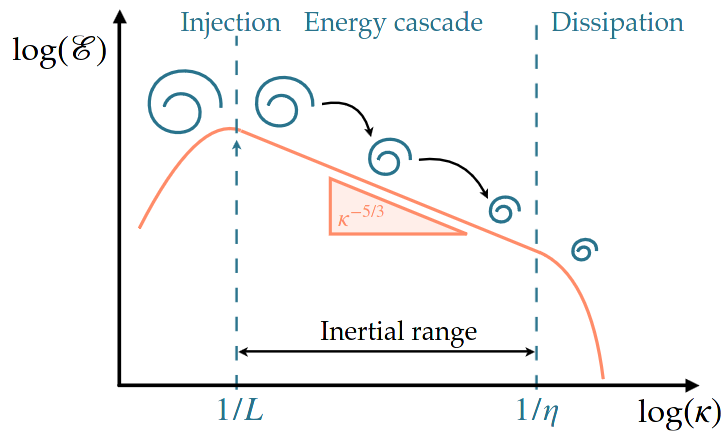
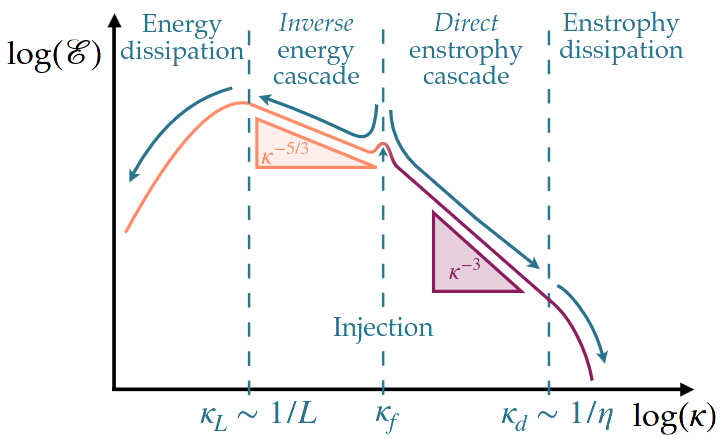
When convection dominates, simulating the incompressible Navier-Stokes equations is characterized by turbulence, a chaotic, three-dimensional, and multi-scale phenomenon. In 3D, it manifests via the energy cascade: the energy is trasferred from the large to the smallest scales, and then dissipated. In 2D, there is a direct enstrophy cascade and an inverse energy cascade.
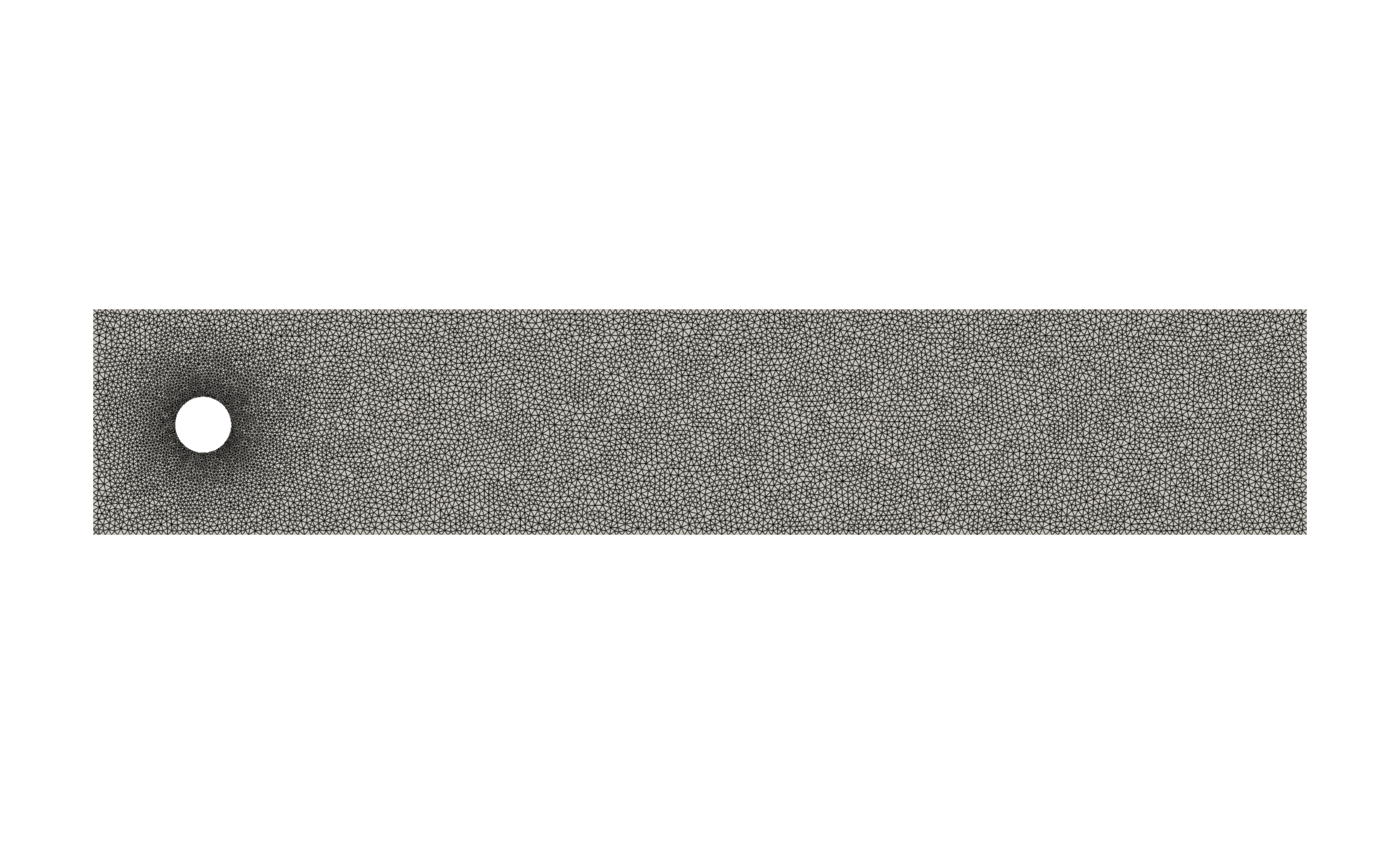
To capture all the scales of turbulence, we need a very refined grid, which can be very expensive and prohibitive. Let's focus on the 2D flow past a cylinder case at Re=1000. We consider two grids, a more refined grid (where we perform the DNS), and a coarser one.
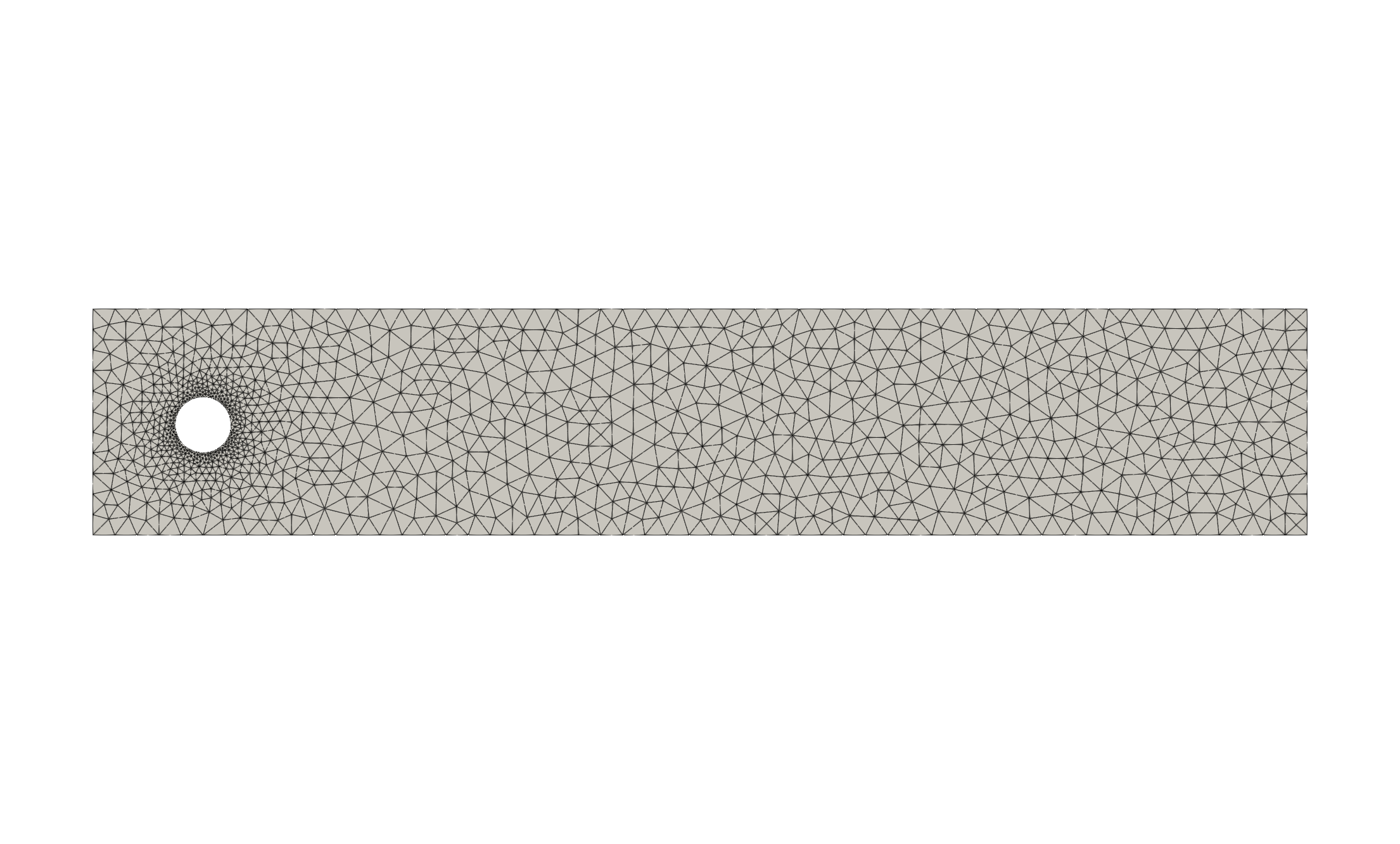
Performing (more affordable) simulations on coarser grids may produce spurious oscillations, as we cut off the smallest scales. The numerical instabilities pollute the solution and eventually lead to a blow up.
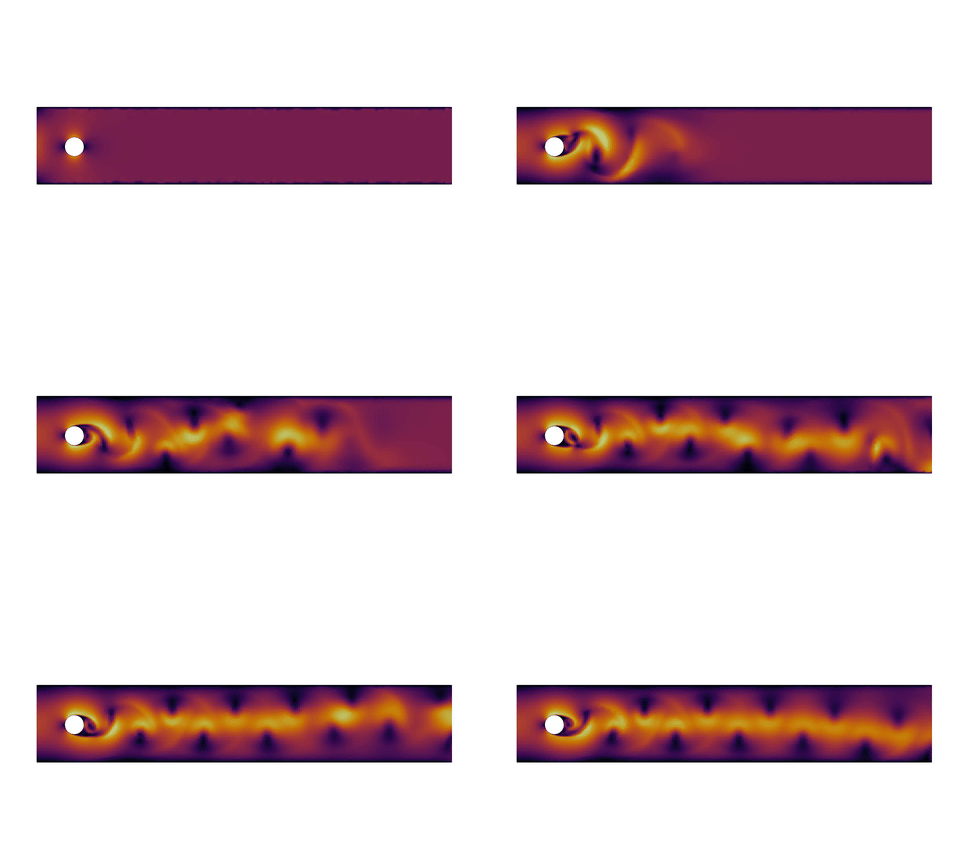
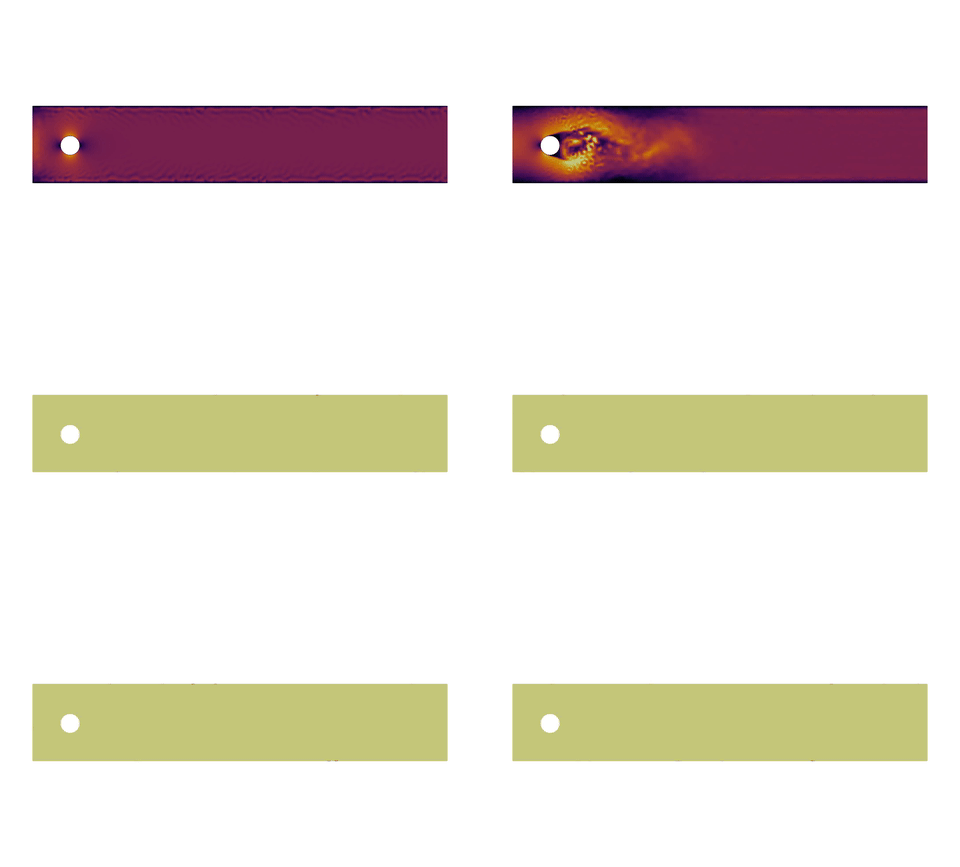
A spatial filter is a smoothing operator that alleviates the oscillations, and reduces the energy at the large wavenumbers (small scales).
The EFR method
The classical evolve–filter–relax (EFR) approach implements the idea of filtering with a fixed, hand-tuned filter. Within EFR, each time step is split into three stages: an evolve step \({\mathbf{w}}^{n+1}\) from the current state (obtained via discretized Navier-Stokes), a filter step
and a relax step
where \(\delta\) is the filter width and \(\chi\in[0,1]\) the relaxation parameter. We will focus here on the differential filter.
There are standard values that are used in literature for \( \delta\) and \(\chi\): the filter radius \(\delta\) is typically related to the Kolmogorov length scale \(\eta=L \,Re^{-3/4}\) or to the mesh size, while the relax parameter \(\chi\) is typically related to the time step size \(\mathcal{O}(\Delta t)\). However, the classical values lead to poor results, either insufficient filtering in EFR or overdiffusive velocity in EF.
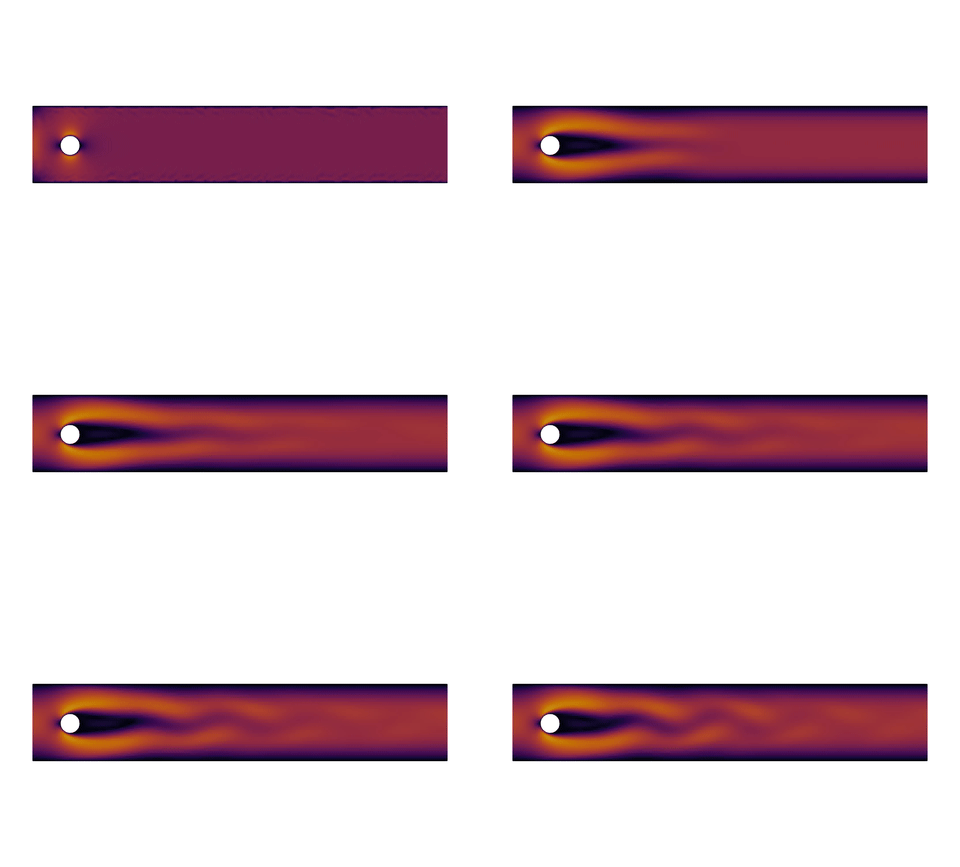
This motivates this line of research on filtering strategies.
-
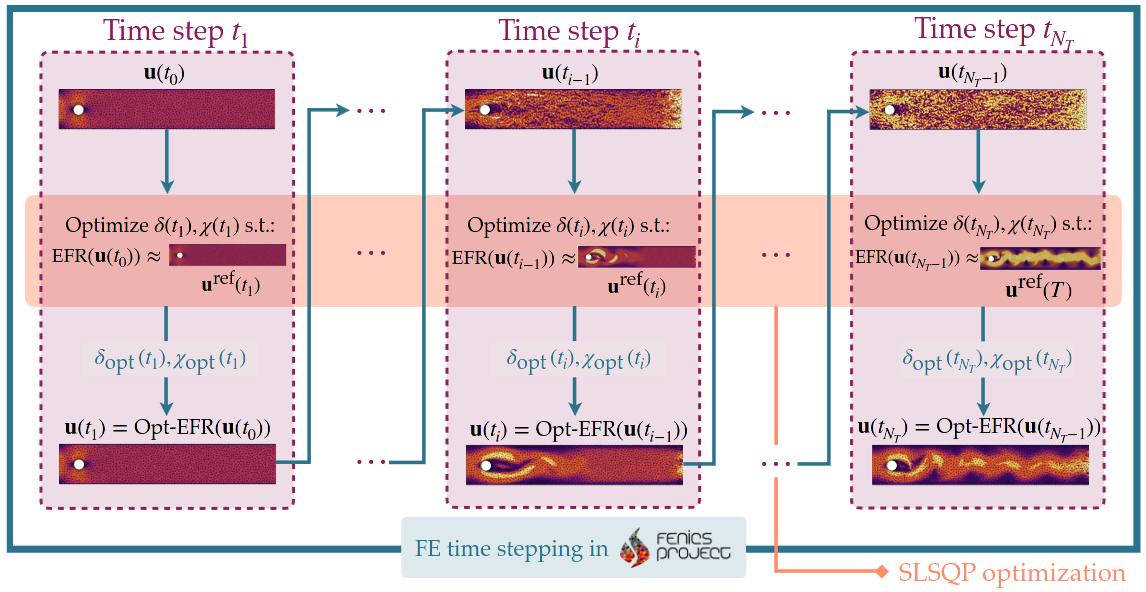
Can we optimize \(\delta\) and \(\chi\) such that our EFR solution is as close as possible to a
reference solution?
-
Can we generalize Opt-EFR to an adaptive filtering method?
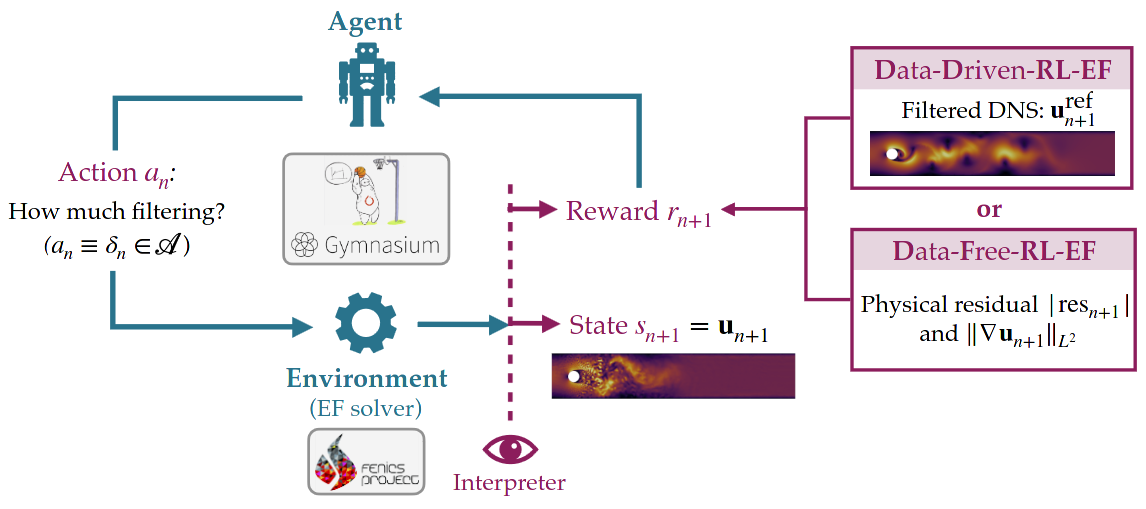
-
What if we replace the differential filter with a data-driven filter?
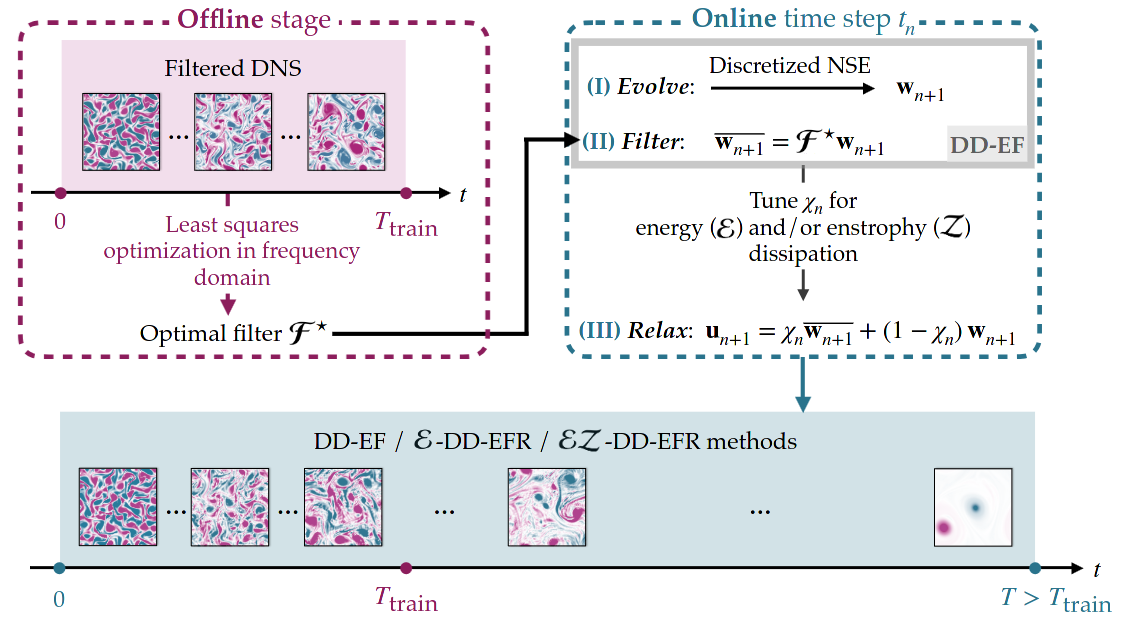
Related publications
-
A. Ivagnes, T. van Gastelen, S. D. Agdestein, B. Sanderse, G. Stabile, G. Rozza,
A new data-driven energy-stable evolve-filter-relax model for turbulent flow simulation,
Computer Methods in Applied Mechanics and Engineering, 2026.
doi ·
arXiv
-
A. Ivagnes, M. Strazzullo, M. Girfoglio, T. Iliescu, G. Rozza,
Data-driven optimization for the evolve-filter-relax regularization of convection-dominated flows,
International Journal for Numerical Methods in Engineering, 2026.
doi ·
arXiv
-
A. Ivagnes, M. Strazzullo, G. Rozza,
Reinforcement learning-based filters for convection-dominated flows: reference-free and reference-guided training,
preprint, 2026.
arXiv